
NATM INSIGHT SERIES CORPORATE MOBILITY IN A CHANGING WORLD | The invisible rules behind business travel – A1 certificates and cross-border work
A meeting in Brussels, a training session in Munich or a factory visit in Belgium. For many organisations these are routine business trips within Europe. International collaboration has become a normal part of daily operations for companies across sectors.
Yet behind this mobility lies a regulatory framework that many organisations only discover when they encounter it in practice.
Within the European Union, national social security systems are coordinated through European legislation. The underlying principle is that an employee may only fall under one social security system at any given time. When an employee temporarily performs work in another Member State, it therefore needs to be determined which system continues to apply.
This is where the A1 certificate comes in.
An instrument rooted in posting and expatriate frameworks
The A1 certificate was originally designed in the context of worker postings. When a company temporarily sends an employee to another EU country for a project, installation or consultancy assignment, that employee may remain covered under the social security system of the home country.
The certificate confirms this status to authorities in the host country and prevents double social security contributions.
For employers, the document provides legal certainty. For employees, it guarantees continuity of social protection, including pension rights and health insurance.
Within the European internal market this mechanism is essential. It allows employees to work temporarily in another Member State without falling into an administrative gap between national systems.
When regulation meets the reality of mobility
However, the reality of modern business mobility often looks very different from the situations for which the rules were originally designed.
International collaboration increasingly consists of short visits rather than long-term postings. Project teams travel between locations, specialists visit client sites for a limited period, and managers travel internationally for meetings or training.
In these situations, the line between posting and business travel can become blurred.
Because European legislation refers broadly to work performed in another Member State, even short professional activities may – depending on interpretation – fall under the same regulatory framework that was originally designed for longer assignments.
For organisations, this can come as a surprise.
An international technology company with project teams across Europe, for example, discovered that even short visits by engineers to client sites could require A1 documentation under certain circumstances. What appeared to employees as a routine one-day trip turned out to be part of a complex system of European social security coordination.
The administrative reality
For organisations, the administrative implications are significant.
Applying for an A1 certificate requires employers to gather information about the employee, the nature of the work and the countries where activities will take place. In the Netherlands, applications are submitted through the Social Insurance Bank (SVB).
Preparing a single application can take between forty-five minutes and an hour, depending on the complexity of the trip and the availability of information.
For companies with limited international mobility the burden remains manageable. For organisations with frequent cross-border travel, however, the number of applications can quickly increase.
Mobility and competitiveness
The discussion surrounding A1 certificates therefore touches on a broader question about the functioning of the European internal market.
European policymakers frequently emphasise the importance of mobility of labour and expertise for economic competitiveness. Cross-border collaboration enables companies to deploy specialised knowledge quickly, organise international projects and accelerate innovation.
If administrative processes no longer reflect how organisations actually work, the flexibility of this mobility can become constrained.
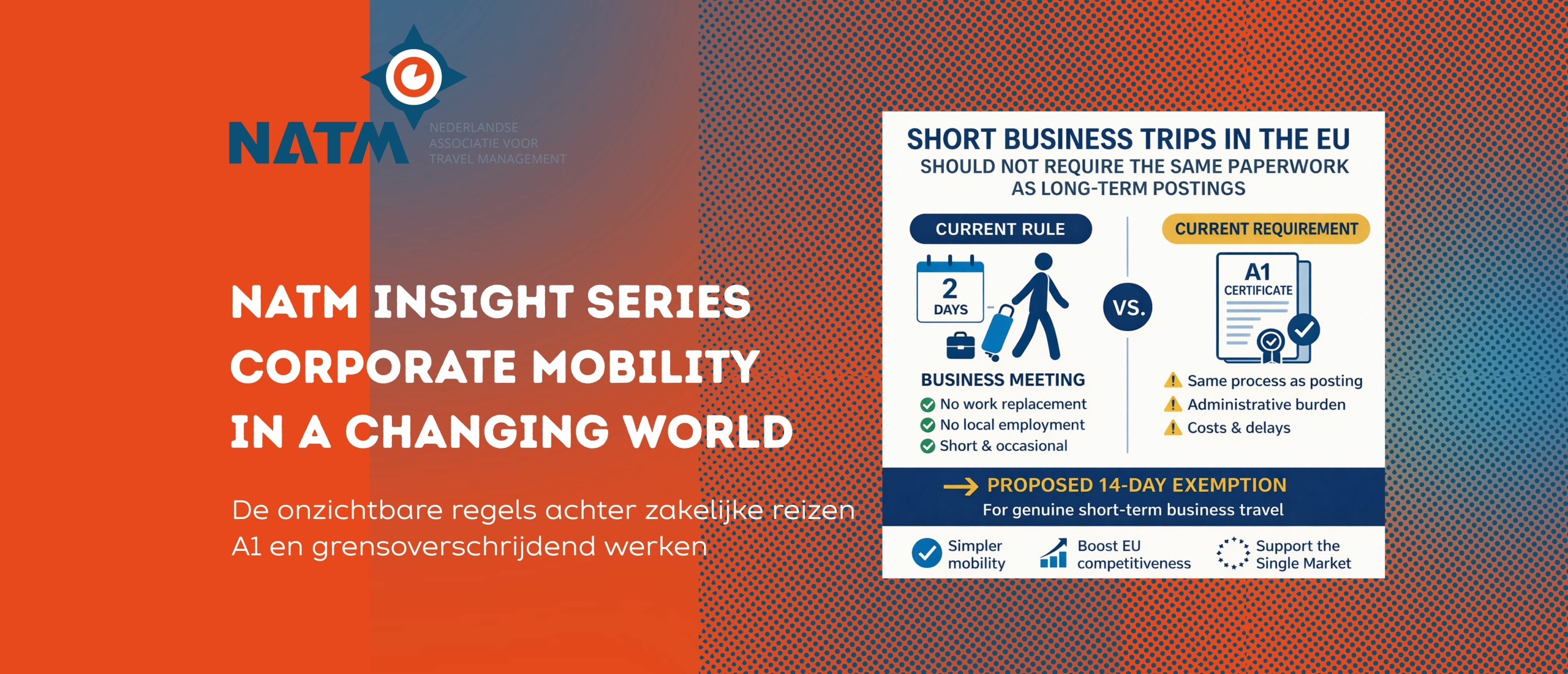
As a result, policy discussions increasingly explore whether short-term business travel should be treated differently from formal postings, while maintaining worker protection and social security coordination.
The role of travel management
The topic also highlights the evolving role of travel management.
Although A1 certificates are often viewed as an HR or payroll matter, travel managers often have the clearest overview of mobility patterns within organisations: who travels, how often and to which destinations.
This insight allows organisations to anticipate administrative obligations and organise international mobility more effectively.
Within the network of the Netherlands Association for Travel Management, this topic is therefore appearing more frequently in professional discussions.
Travel managers increasingly observe that their responsibilities extend beyond operational trip organisation towards a broader role in managing international mobility.
Business travel today touches not only logistics, but also regulation, compliance and governance.
The link between practice and European policy
The journey itself remains visible.
The regulatory structure behind it often remains hidden.
Yet it is precisely this structure that increasingly determines how simple — or how complex — international mobility within Europe ultimately becomes.
Against this backdrop, the topic is increasingly addressed not only at organisational level, but also within European policy discussions. Through BT4Europe, the Netherlands Association for Travel Management contributes to the dialogue on how A1 requirements apply to short-term business travel.
The focus of this discussion is not to challenge worker protection or social security coordination, but to explore whether a more proportionate approach — such as a targeted exemption for short-term business travel — would better reflect the reality of modern corporate mobility.